
Vintage and Antique-Inspired
Finding a Modern Antique-Inspired Engagement Ring
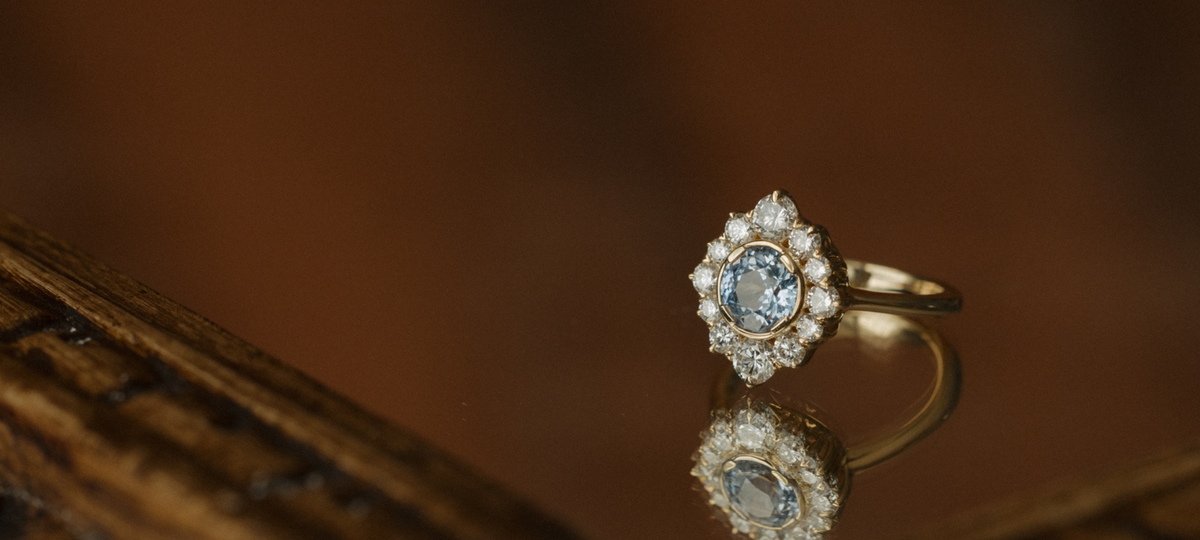
Our No. 08, a bezel-set unheated Ceylon sapphire framed by an antique-style diamond halo.
How to Find an Engagement Ring That Feels Antique, Not Dated
Before modern cutting tools existed, diamonds were shaped by eye and by hand. That's why antique cuts look softer and less uniform than a modern round brilliant, and why they give off broad flashes of light instead of a fine, glittering sparkle. Many antique-cut stones also lean slightly warm in color, and that isn't a flaw. They were cut to be seen by candlelight, where a little warmth is part of their character, which is why they're often described as "cut for candlelight." We use many of these cuts for their romantic warmth and glow.
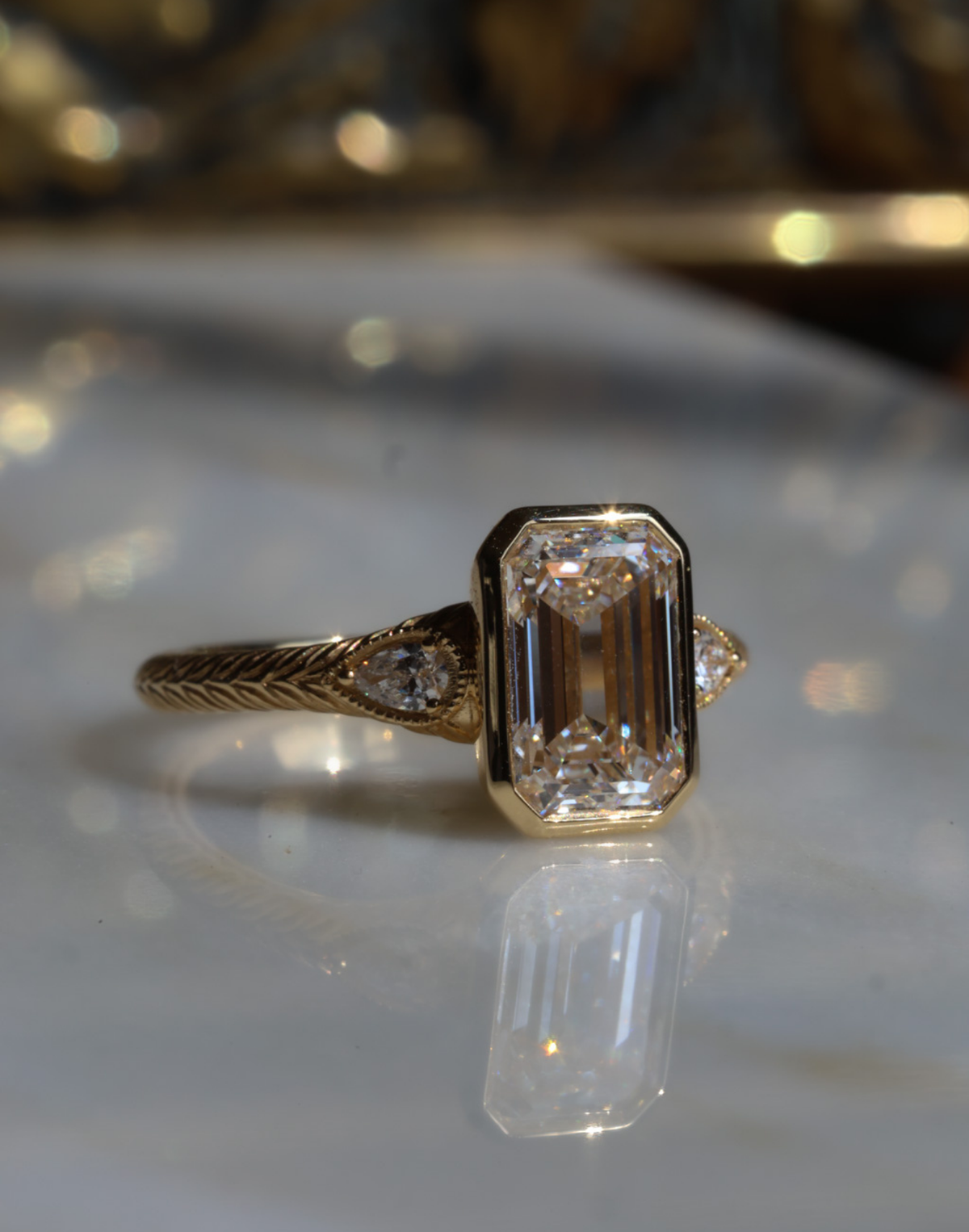
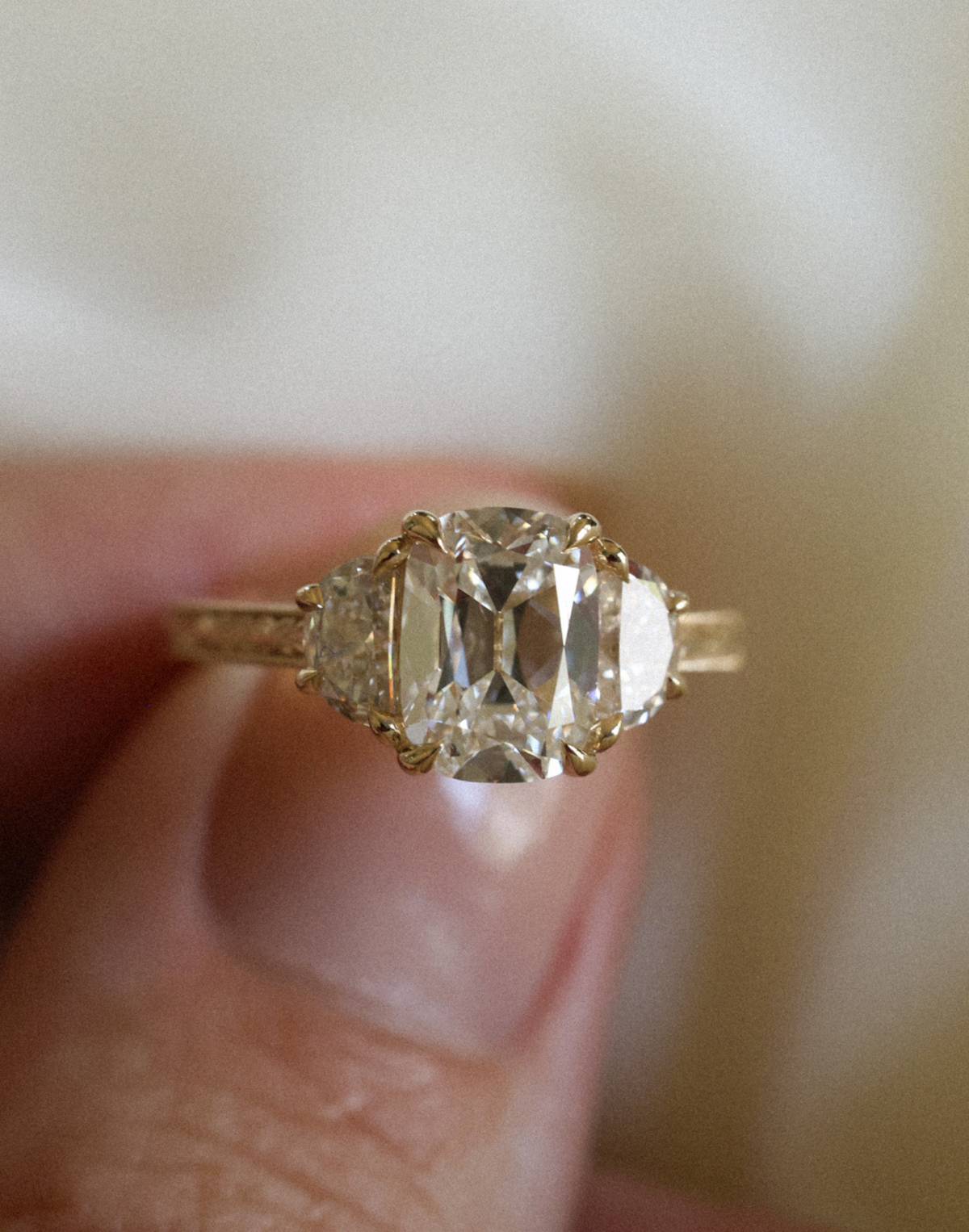
A bezel-set emerald cut with pear diamond side stones and our hand-engraved wheat, our No. 16 shows how we balance antique and contemporary elements.
What Does "Vintage-Inspired" Mean?
The terms get used loosely, so it helps to separate them:
An antique ring is more than 100 years old.
A vintage ring is generally between 20 and 100 years old.
A vintage-inspired (or antique-inspired) ring is newly made, but borrows from the past. It may have an older setting style, an antique-cut center stone, or details like engraving or milgrain, all brought into a new piece that blends antique and modern.
Inspired is not the same as a replica. A reproduction tries to copy a specific period piece exactly. That isn't what we do at Moonryvr. The goal is a ring that feels like it has a history, while still being entirely its own.
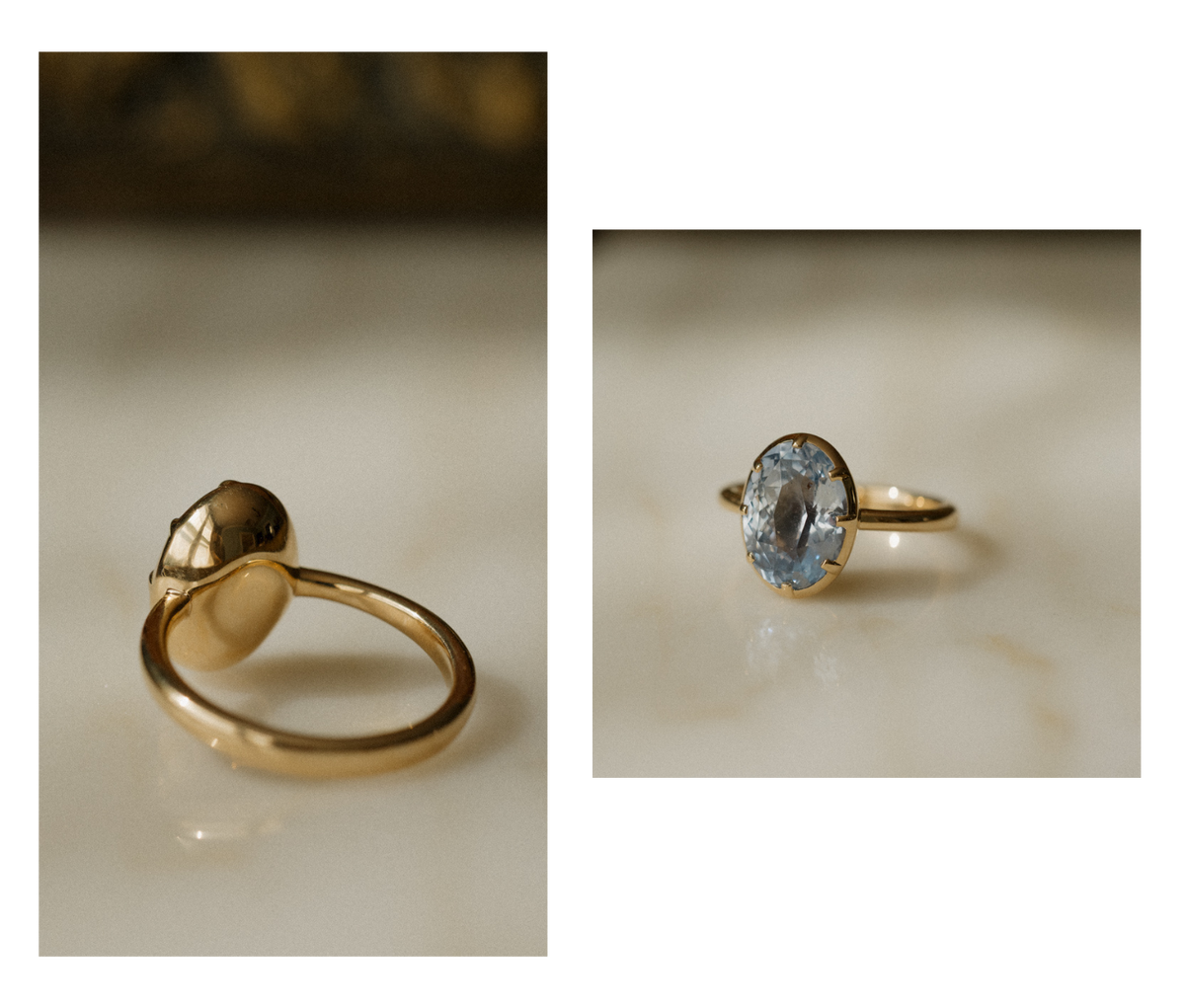
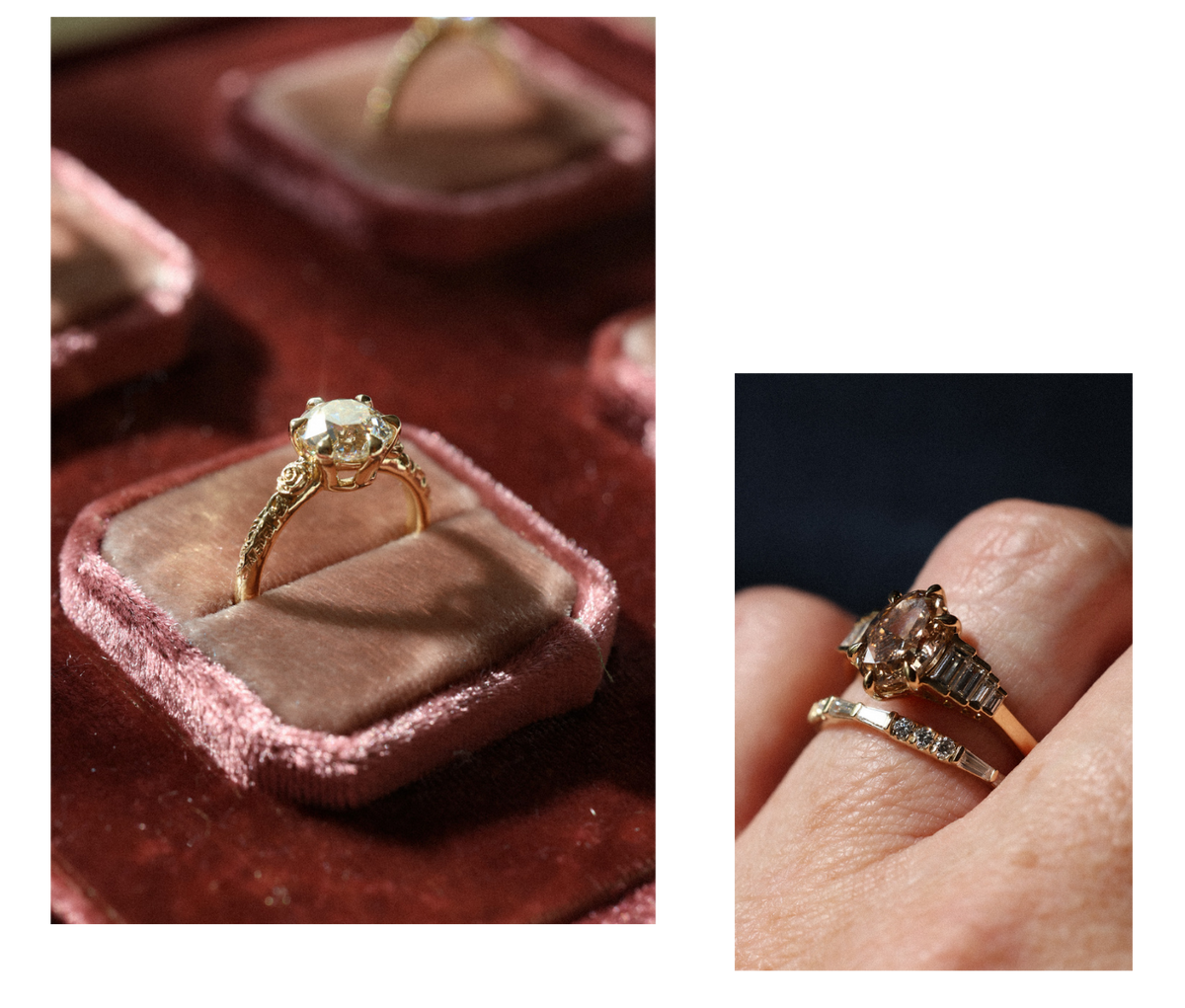
Our No. 04 holds an unheated Ceylon sapphire in a closed back collet, an older version of the collet setting.
What Makes an Engagement Ring Feel Antique?
1. The Diamond Cuts
Old Mine Cut: A gently rounded, cushion-like shape with a high crown, a small table (the flat facet on top) and an open culet (a tiny flat facet at the bottom point), which you can sometimes see as a small circle at the center of the stone. Especially popular through the 1700s and 1800s, in the Georgian and Victorian eras.
Old European Cut: The round ancestor of today's round brilliant, with the same high crown and open culet. Popular from roughly the late 1800s into the 1930s, across the late Victorian, Edwardian and Art Deco eras.
Rose Cut: A flat base with a domed top covered in triangular facets. Rose cuts don't sparkle so much as glow, and they often look larger for their weight because they have no pavilion (the cone shaped lower half of most diamonds). Used since the 1500s, and especially loved in Georgian and Victorian jewelry.
Antique Step Cuts: Antique emerald and Asscher cuts. With deeper steps and cut corners, they show depth more than brilliance, like looking into still water. Step cutting is centuries old, and the emerald cut takes its name from the gemstone it was first used on. These cuts had their biggest moment in the 1920s and 1930s, the Art Deco era.
2. The Setting Styles
Collet Settings: A collet is a collar of gold that wraps around the stone, often set up on a small gallery. It's one of the oldest settings in jewelry, and a favorite of Georgian and Victorian jewelers. Early collets were usually closed at the back and lined with a thin metallic foil to brighten a stone by candlelight. Today's collets are often left open underneath and paired with small claws, so the stone gets more light and keeps the same old-world look.
Bezel Settings: A bezel is a smooth rim of metal that surrounds the stone completely. It goes back thousands of years and was one of the first ways people set stones at all. Like early collets, older bezels were often closed at the back, which made them secure but kept light from passing through. Modern bezels are typically open underneath, and they're still the most protective setting since the metal guards the stone's edge. This makes a bezel especially good for everyday wear or for someone wanting extra security for their ring.
Prong settings: Prong settings hold a stone with slender claws instead of a wall of metal, which opens up its back and lifts it away from the band, so light can reach it from the sides and below. Antique-style prongs still look a little different from modern ones, often six or eight slender claws instead of four, or shaped like compass points or double claws. In 1886, Tiffany & Co. introduced its six-prong solitaire, which raised a single diamond high above a plain band. It wasn't the first ring with prongs, but it made the raised solitaire the defining look of the engagement ring.
Open Gallery Settings: The gallery is the part of the setting beneath the stone, what you see when you turn a ring to the side. Once prongs lifted stones up off the band, that space became somewhere to add detail. Victorian rings often used a coronet (or crown) gallery, a ring of tall claws flaring out like a small crown. Pierced openwork, a setting where jewelers were able to use platinum to create lace-like galleries, became popular during the Edwardian era as platinum became more accessible. In the Art Deco years, filigree galleries took over with fine, geometric patterns cut and stamped into the metal. Modern open galleries borrow from all of these, with arches, petals and cut-outs that show up once the ring is turned.
Halo Settings: A halo is a ring of small stones set around a center stone. Georgian and Victorian cluster rings gathered small diamonds around a center, and Edwardian and Art Deco jewelers refined the idea into a crisp halo framing a sapphire or a diamond. A halo makes the center look larger and frames it with light, and antique-style halos often use single cut or old-cut accent diamonds, which have fewer facets and glint more softly than modern pavé.
3. The Craftsmanship
Hand Engraving: Hand engraving adds a pattern cut into the metal with a small hand tool called a graver. The patterns are often wheat, scrollwork, leaves and flowers. Hand-cut lines have depth, catch the light, and have slight irregularities where machine and laser engraving look flatter. Some motifs carry meaning too, like the orange blossoms that became a popular bridal symbol after Queen Victoria wore them in place of a tiara at her wedding in 1840.
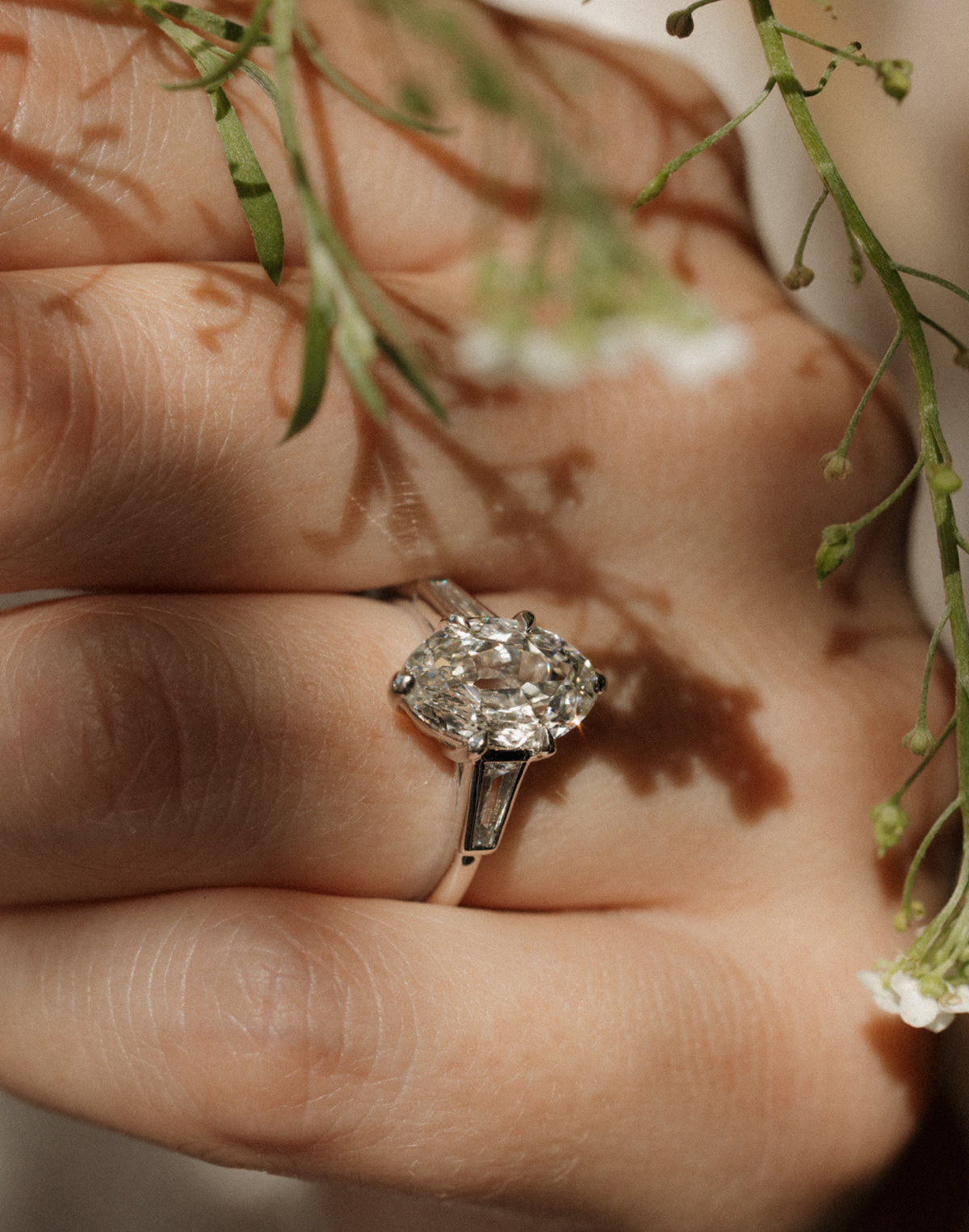
Milgrain: Taking its name from the French mille grains, "a thousand grains," milgrain is a fine border of tiny raised metal beads. It's often used to outline bezels, galleries and the edges of bands, and it was especially loved in the Edwardian and Art Deco eras. Up close, milgrain softens the edge and adds a texture that catches the eye, one of the quietest ways to add a handmade touch to a ring.

An oval rose cut diamond in a curved bypass halo, our No. 11 is shown here in rose gold.
How Moonryvr Balances Antique and Modern
Choose a Lower Setting for Everyday Wear
Many antique settings sit high, which shows off the stone but can catch on sweaters and has a higher risk of knocking into things. A lower setting keeps the stone closer to the hand, and can be a great option compared to taller settings. It's easier to wear every day, can be more comfortable, it protects the stone, and can be ideal if you work with or have young children. Bezels and low collets are both good places to start for extra security for your stone.
Set an Old Cut in a Cleaner Setting
An antique cut already carries the history, its soft outline and broad flashes of light do most of the work. Put it in a clean bezel or a few claw prongs, and the stone looks storied while the ring looks clean. It's one of the easiest ways to get the feeling of an antique without creating something overly flashy or something that looks genuinely old and dated.
Look for Old Proportions, Not Decorative Motifs
Much of what makes a ring feel antique is in its shape rather than just its ornament. Chunky facets, elongated shapes, a band with a little more weight to it, and a center stone that sits in balance with the rest. Proportions like these feel quietly aged without adding a single laurel leaf or scroll. If you choose to add one or more decorative elements, it helps to pick only a few so as to not overwhelm the ring.
Choose One or Two Antique Details, Not All of Them
A ring doesn't need filigree, a halo, engraving, milgrain and an antique cut all at once to feel like an heirloom with a story. Stacked together, they start to read as a costume and can overshadow each other. One or two well chosen details say more, an old mine cut on a plain band with compass prongs, or a simple solitaire with an engraved shank. Coco Chanel is often credited with saying: “Before you leave the house, look in the mirror and remove one accessory”. This is applicable in this instance as well. Give each detail room, and the ring feels storied rather than staged.
Where Should You Start?
Starting With the Stone
We usually begin with a specific center stone or a type of stone, like a round rose cut, and design around it. From there, we think about which details are authentic to that stone and how to layer them in, so the design grows from the stone.
Not Every Part Has to Feel Old
It is an intentional choice not to make every part of a ring feel antique. We might pair an antique-cut stone with a clean bezel or four prongs, which feels modern compared to an antique setting that may have used eight or twelve. That mix is what keeps a ring from looking like a period piece, and gives the ring a distinct “I can’t quite place what era that belongs to” ageless feeling.
Restraint
A ring could carry eight design elements layered on top of each other for a very ornate, antique look, but we'd rather take some away. With fewer layers, the piece feels quieter and each detail has room to be seen instead of being crowded by the others. We keep taking away until removing anything else would leave it wanting.
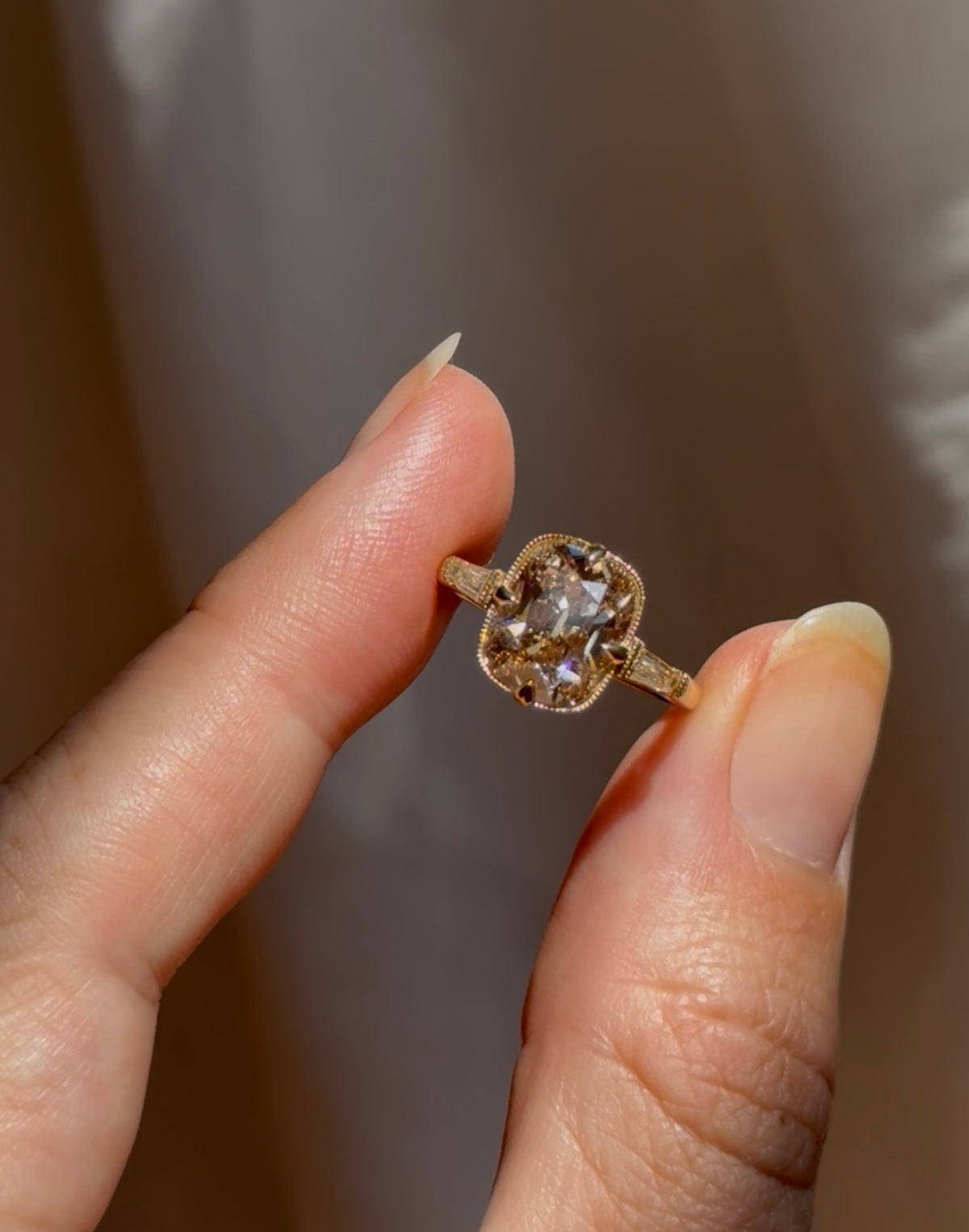
Our No. 19, a champagne old mine diamond bordered in hand-dotted milgrain, with a tapering baguette on each side.
Written by our designer and founder, Katie Wright
Products shown: No. 08 Antique Halo Ring in Ceylon Sapphire, No. 16 Bezel Set Ring in Emerald Cut Diamond, No. 10 Ring in Old Mine Oval Diamond, No. 04 Collet Set Ring in Ceylon Sapphire, No. 11 Oval Rose Cut Diamond Ring, Bespoke Ring Old Mine Orange Blossom Engraved, No. 13 Engagement Ring in Old European Cut Diamond, No. 09 Oval Engagement Ring in Desert Diamond, No. 19 Champagne Old Mine Diamond Ring